Projects Resume Artwork
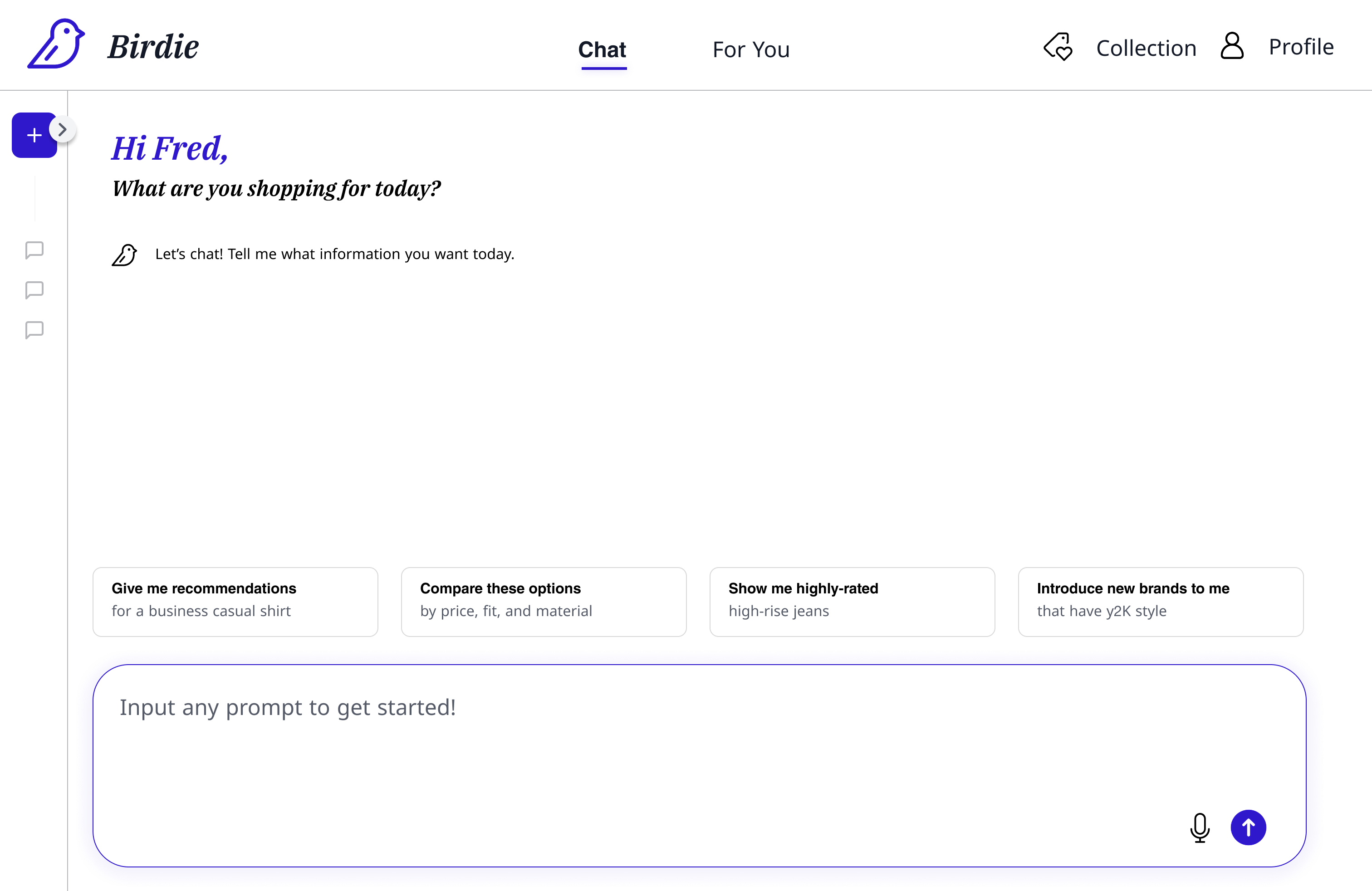
Birdie Landing Page

Birdie: AI-Powered Fashion Shopping

Summary

Sponsored by tech and business consultancy Slalom, my team investigated the role of AI in modern shopping, then used findings to design Birdie, an AI-powered fashion shopping platform, as part of the GTech Master's in Human-Computer Interaction program's core course, Psychological Research Methods in HCI.

Responsibilities

UX/UI Design
UX/UI Research
Stakeholder Management

Impact

Presented our work to Slalom and provided them with data about shopper's AI usage as well as our prototype to advise their clients in the retail sector.

Problem

Generative AI (GenAI) chatbots are becoming widely used by online shoppers.
However, they aren't tailored for shopping assistance and diminish brand's control over their visibility and representation to consumers.

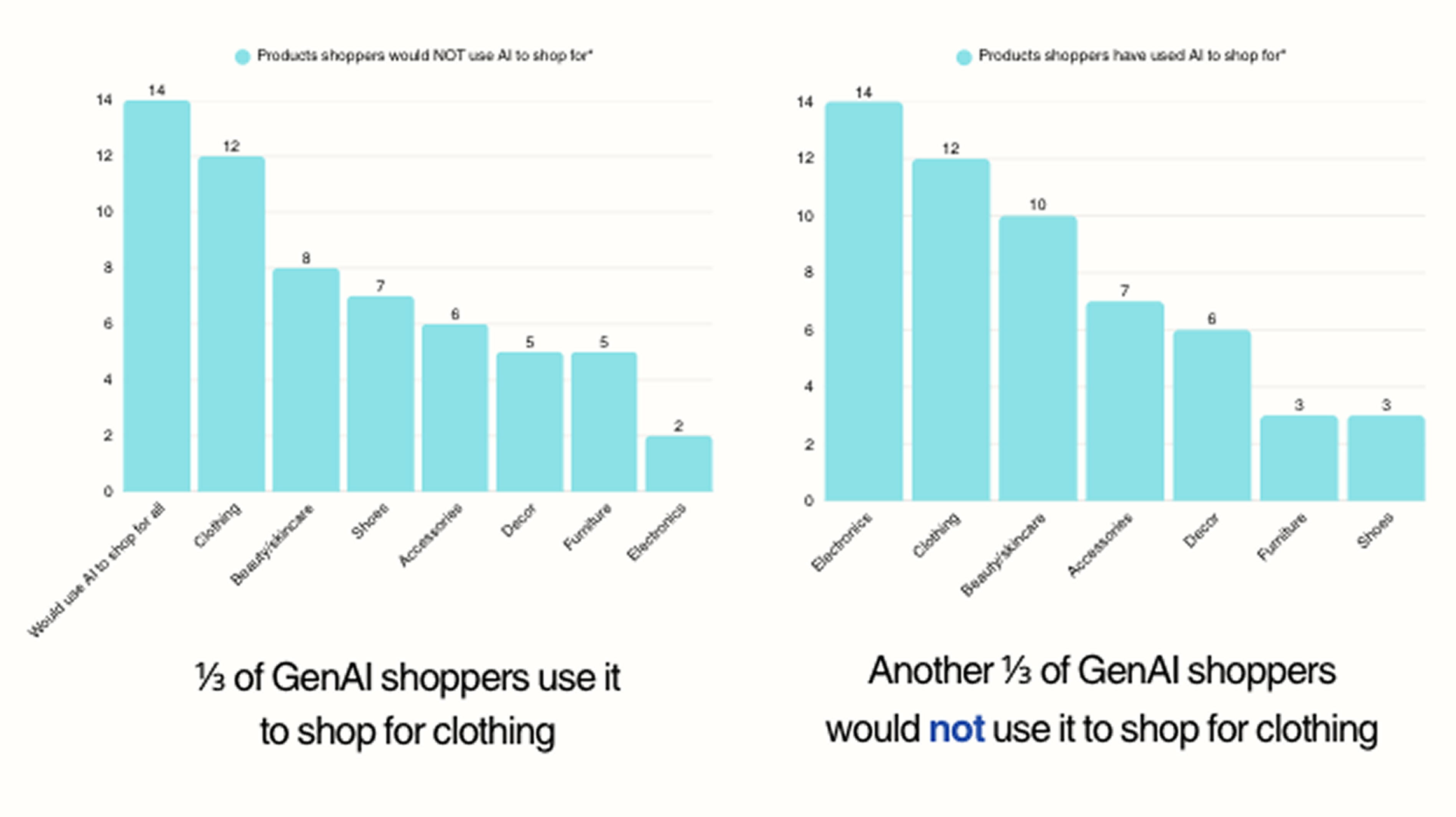
Looking at Adobe's 2025 survey of 5,000 US consumers:
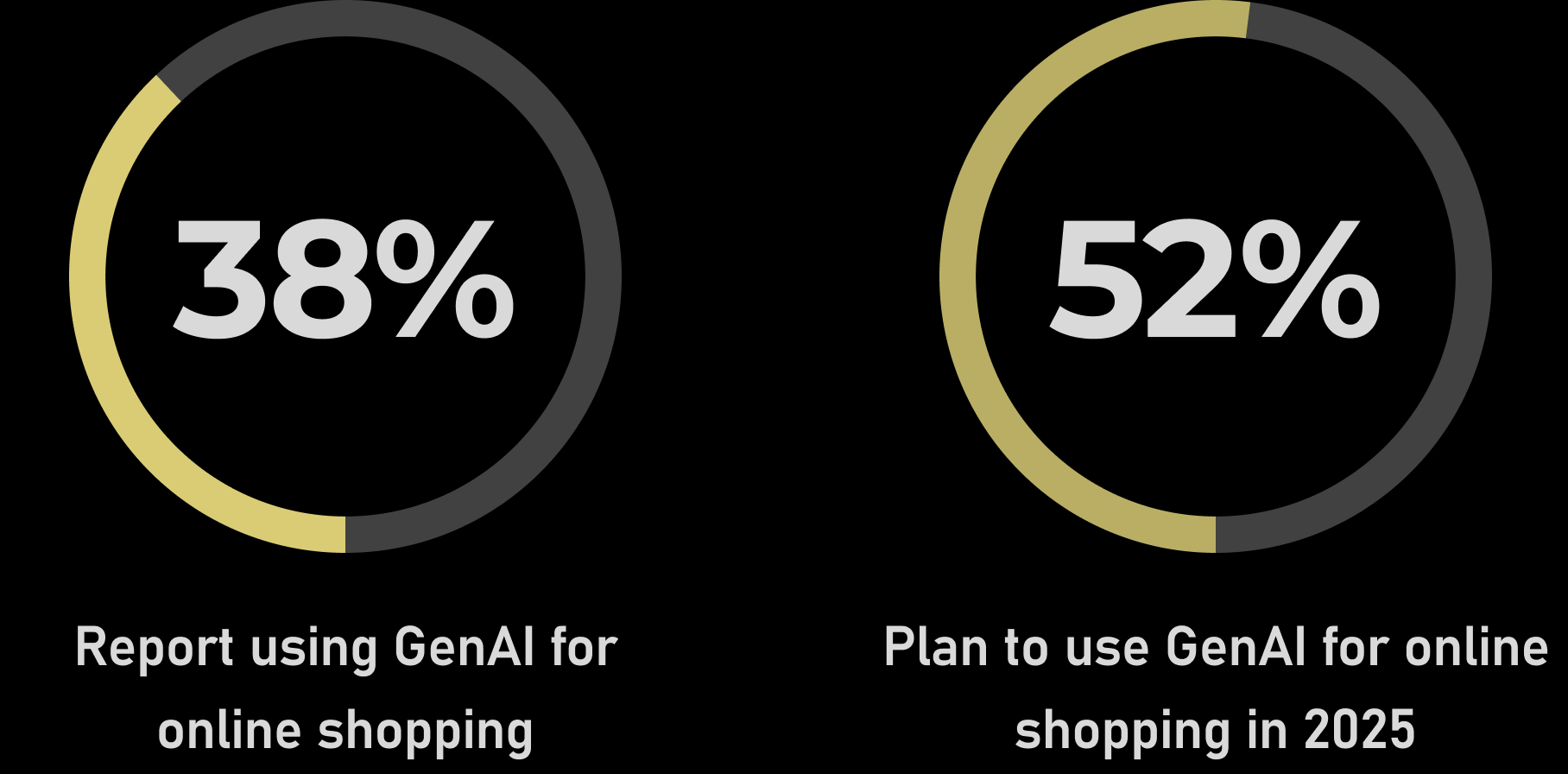
AI & Shopping Stats

Slalom asked us to discover how brands can take back this control.
We also wanted to design a product to help shoppers best leverage the power of GenAI.

Design Statement

How might we design something that helps shoppers use GenAI, while maintaining brand visibility and representation?

Research

Before beginning, we identified our target users as shoppers in their 20s.

This group would most likely be already familiar with AI tools and more willing to shop across multiple brands.
Afterwards, we conducted 4 research methods:

Online Survey

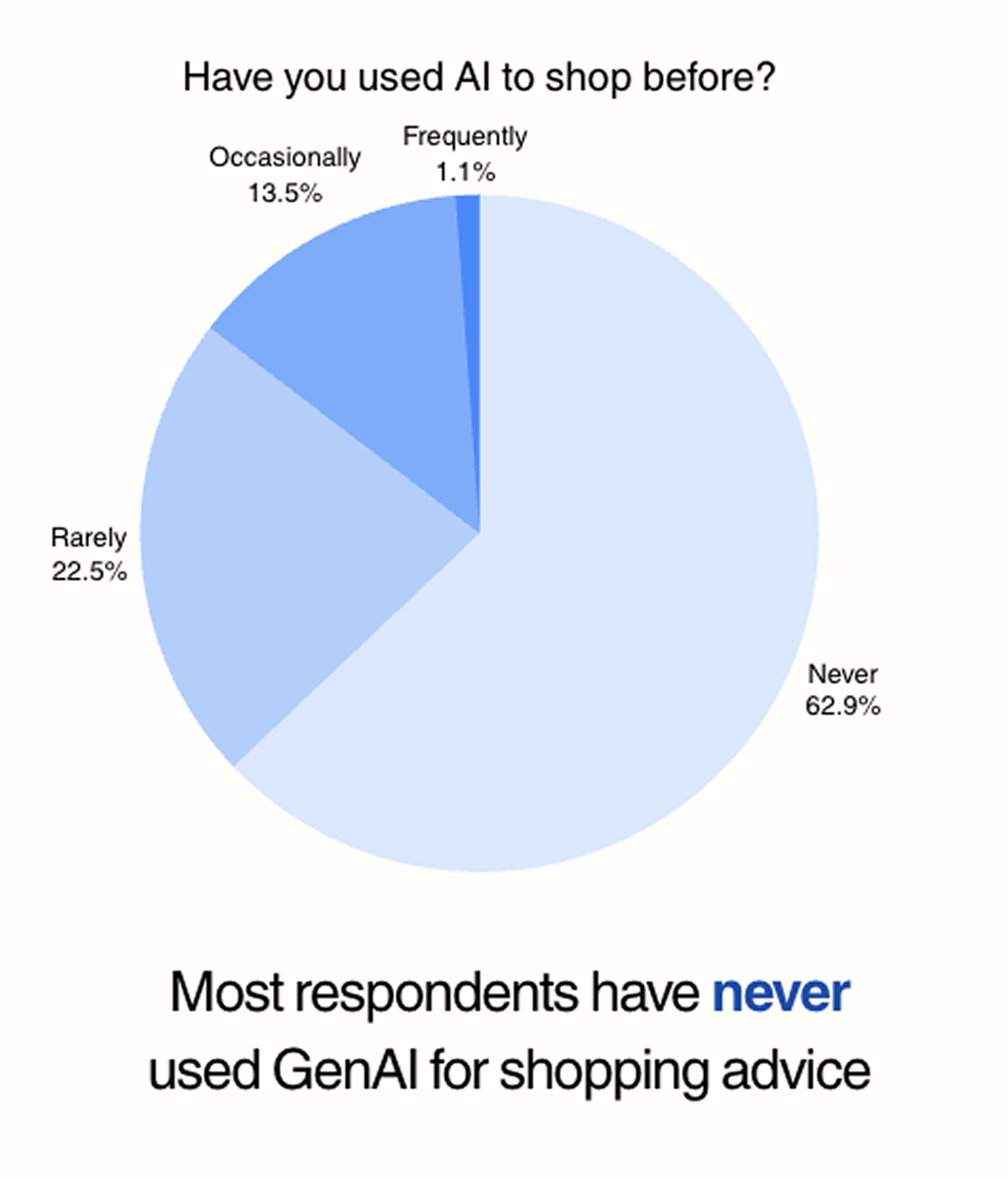
Goal: Gauge user's extent of AI usage.


Details

  • Administered to 89 target users via Qualtrics

Takeaways

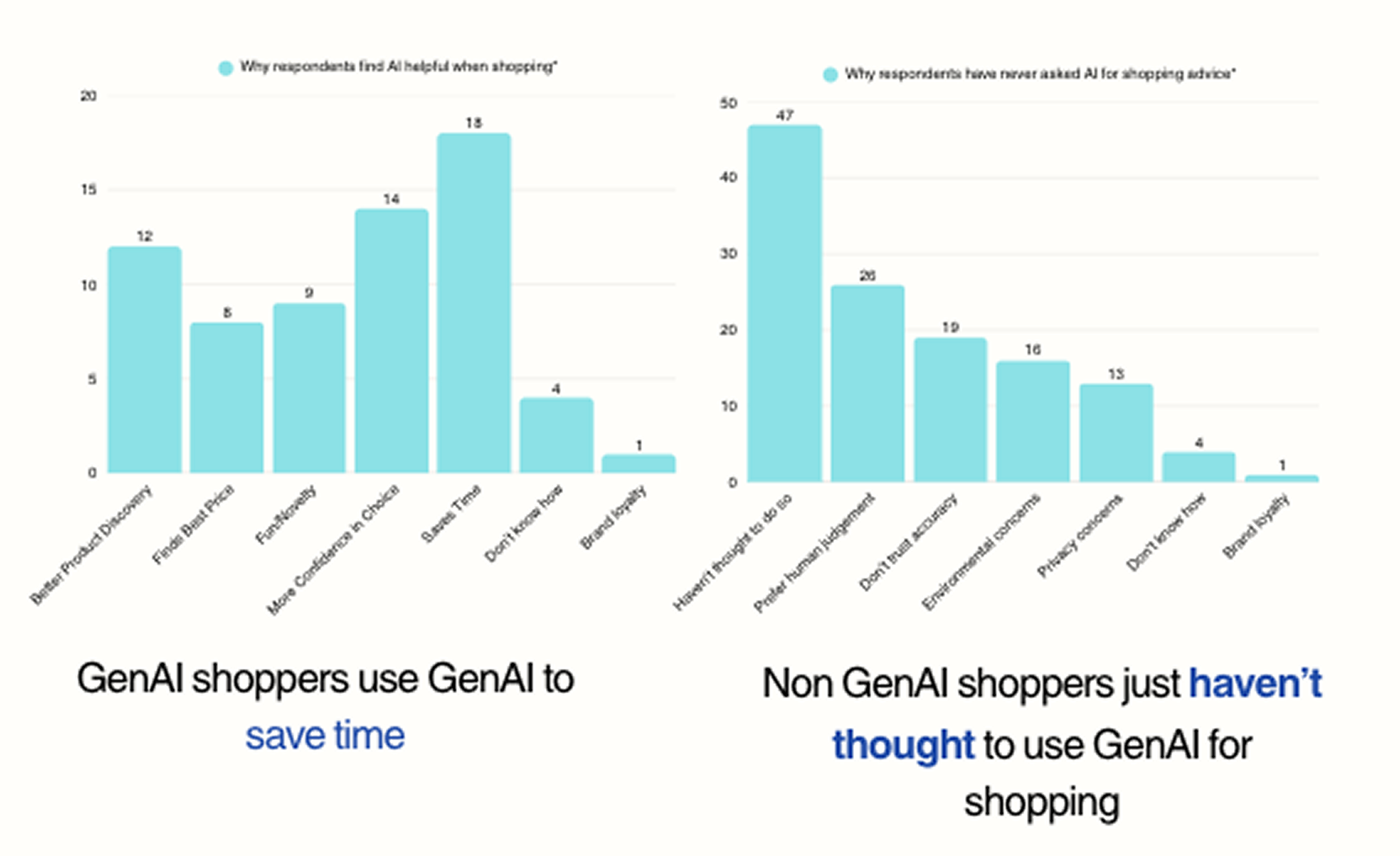
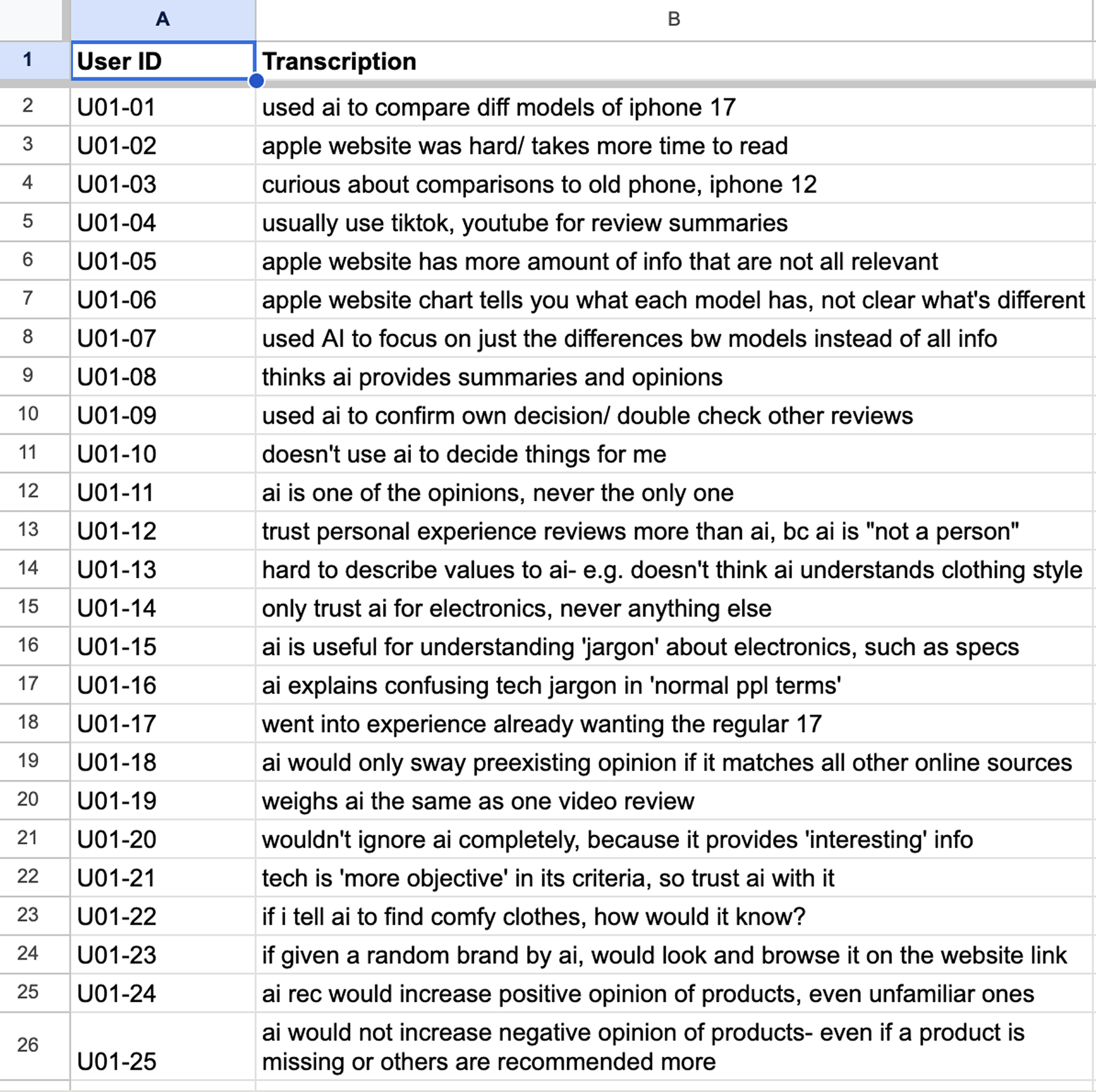
  1. Shoppers who don't use GenAI need awareness of how GenAI can help.
  2. Shoppers who use GenAI are split on whether to use it to buy clothes.

    Further investigation into the fashion shopping domain is required.
Survey

Semi-Structured Interviews

Goal: Understand why users use or don't use GenAI to shop for clothes.

Details

  • Conducted 8 total sessions with survey respondents
  • Explored their survey responses, trust in AI, personal motivations, and brand values based on their past usage of AI tools

Takeaways

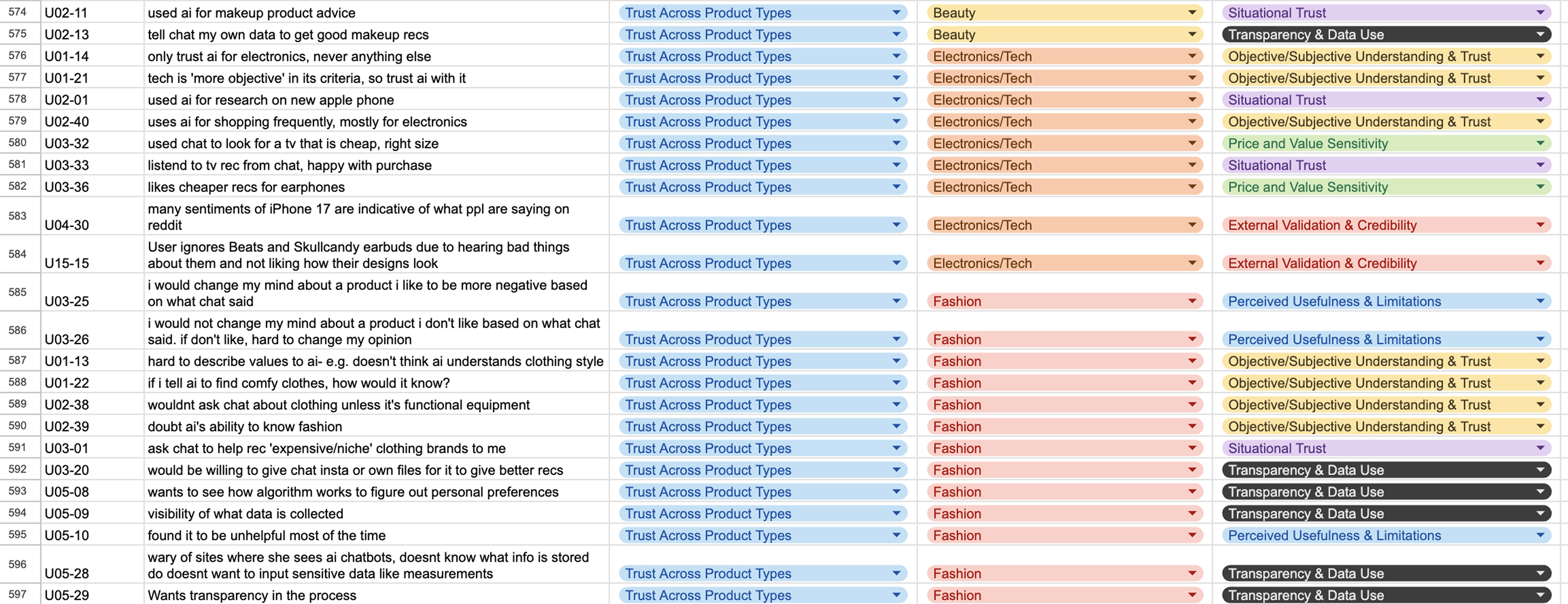
  1. Shoppers use AI to save time and quickly find important information.
  2. Shoppers doubt AI can grasp personal fashion style, making them hesitant to use it for clothing discovery.
Interviews

Contextual Inquiries

Goal: Observe how users interact with GenAI and dig into their frustrations.

Details

  • Conducted 8 total sessions with survey respondents
  • Prompted non-AI shopping users to shop for a specific product, and AI shopping users to recreate a previous interaction
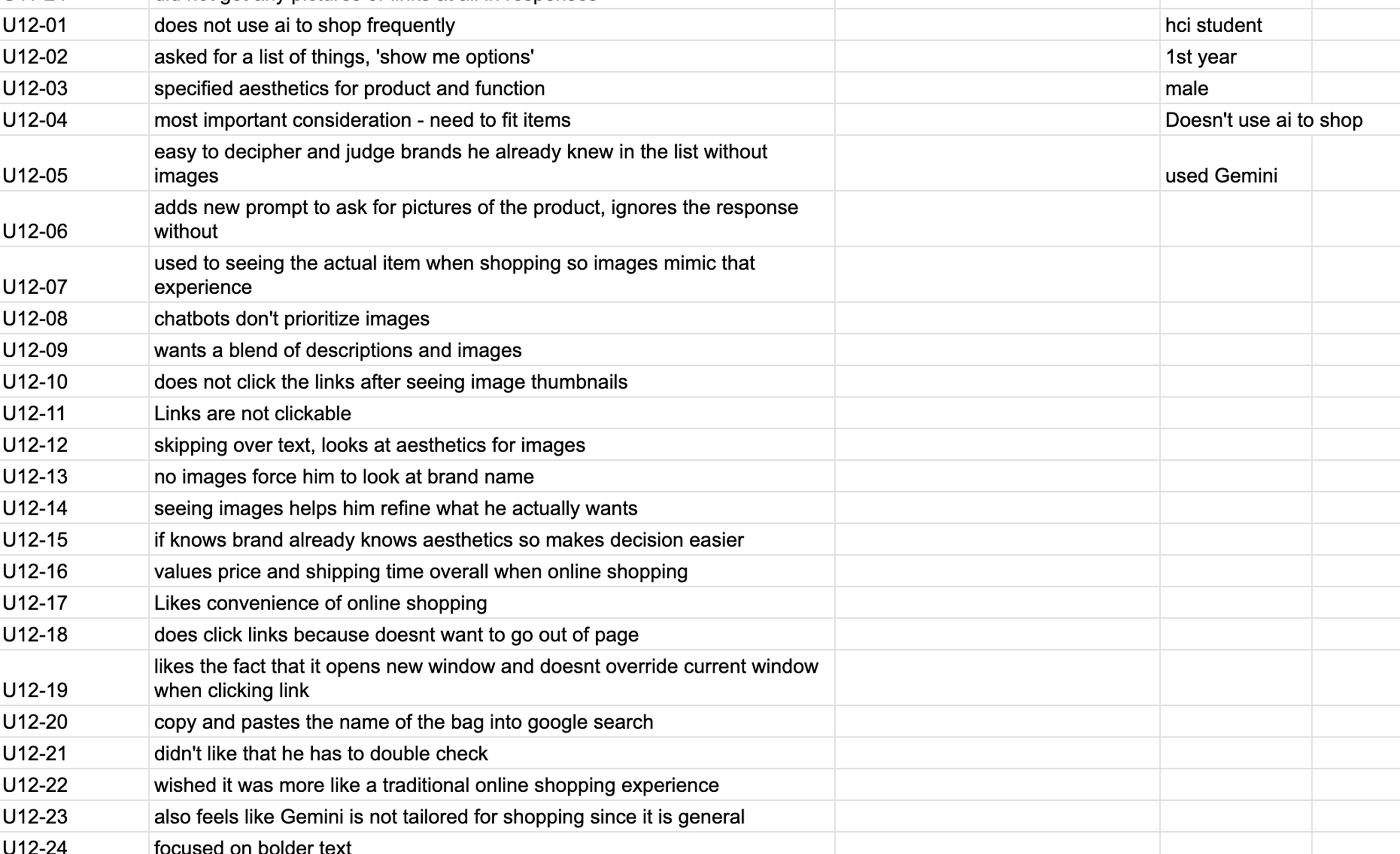
  • As this method's lead, I set up a guide for my team on how to conduct sessions and what details to focus on. I also personally conducted a pilot and 2 real sessions.

Takeaways

  1. Shoppers are frustrated by AI's lack of transparency on where it gets its information, including product descriptions and shopper reviews.
  2. Shoppers expect concise responses with real product images/photos and minimal text.
  3. Shoppers don't give AI data about their own fashion style, leading to irrelevant recommendations.
Contextual Inquiries

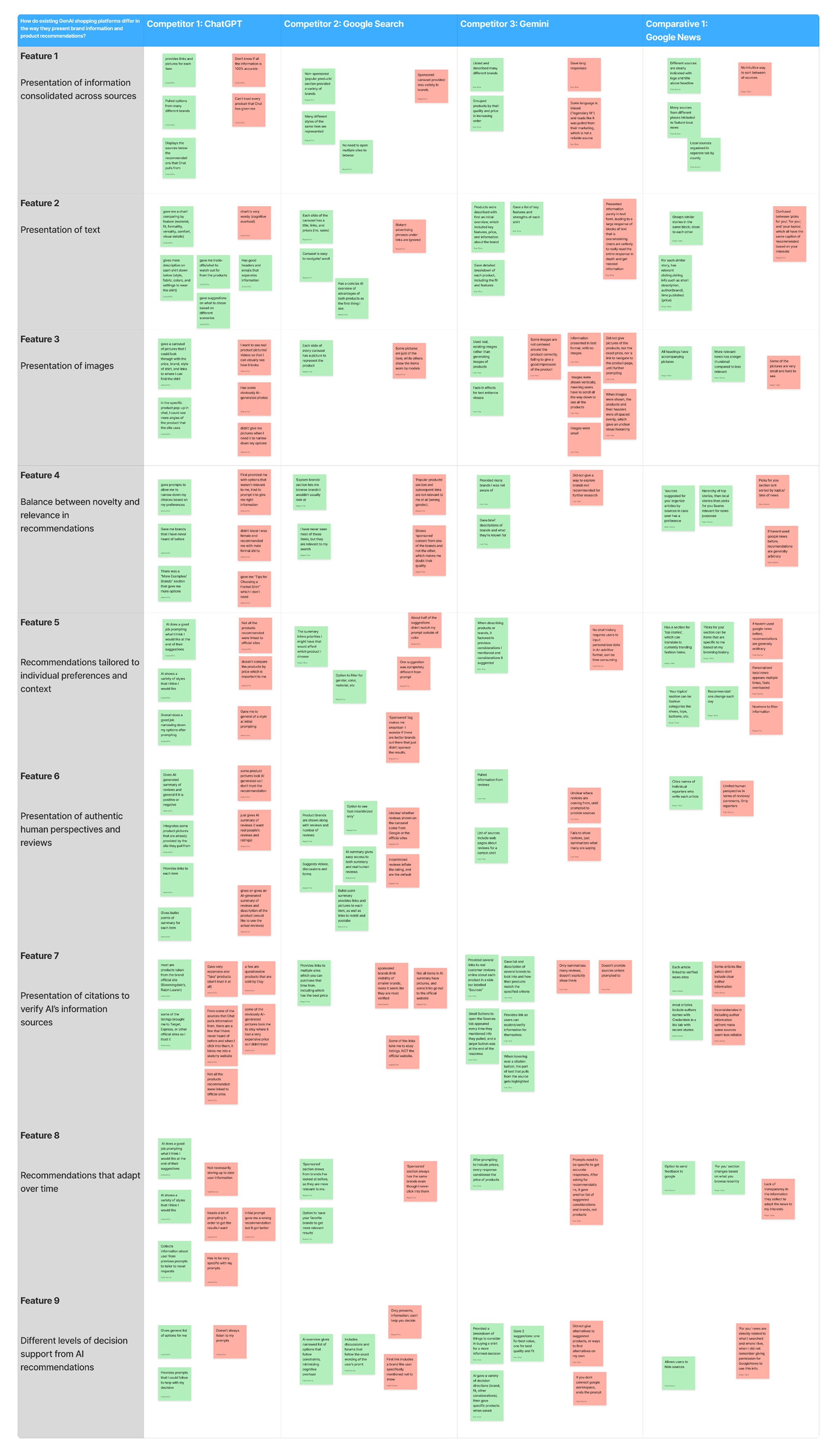
Competitive/Comparative Analysis

Goal: Assess how existing products support or fail to support user needs when shopping for clothes

Details

  • AI Competitors: ChatGPT & Google Gemini
  • Non-AI Competitor: Google Search
  • Comparator: Google News
    • Consolidates large amounts of important information, similar to AI chatbots
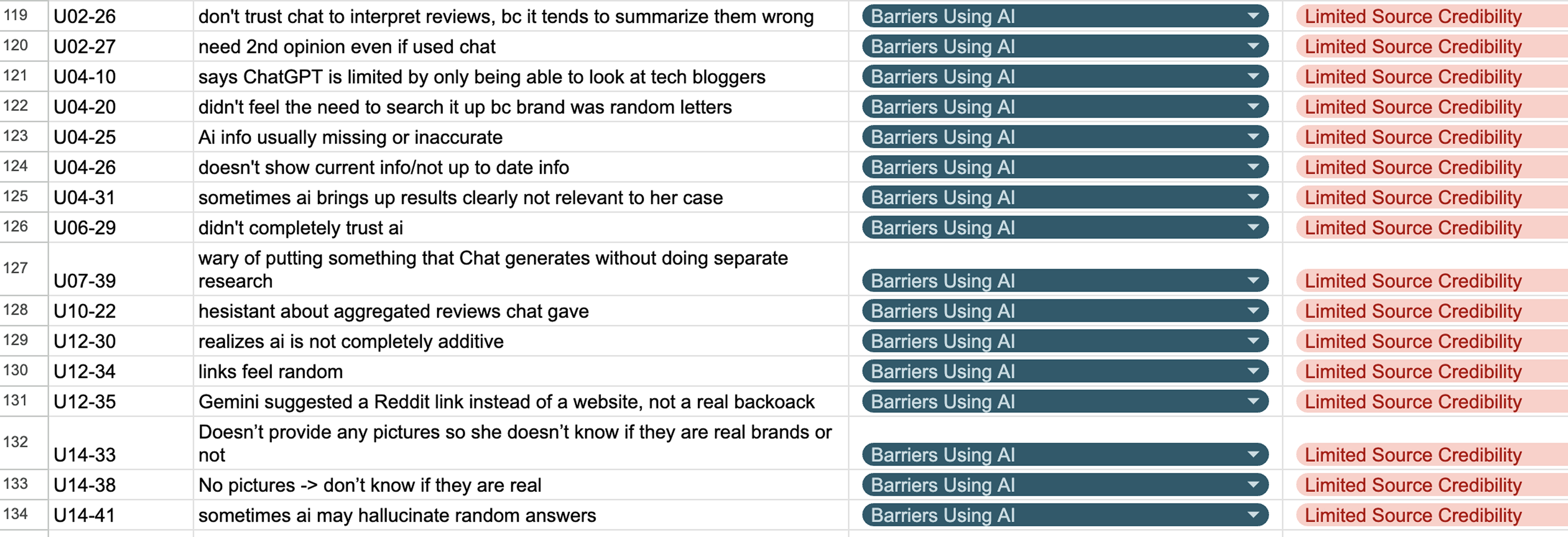
  • As the lead of this method, I did some research into how to efficiently conduct a C/C analysis, then set up a table in FigJam to organize our findings. I also did an analysis of Google Gemini.

Takeaways

  1. Existing products fail to consistently pull from reliable sources and cite them.
  2. Existing products lack shopping-specific features (e.g. wishlists, product comparisons, etc.).
Competitive/Comparative Analysis

Design: Ideation

At this point, we struggled with differing expectations amongst our sponsors and the course project.

Slalom wanted to help their retail clients be visible and represented through AI, and we needed to design a product for our target users using all our research.

Each of my team members put a lot of thought into some design ideas.

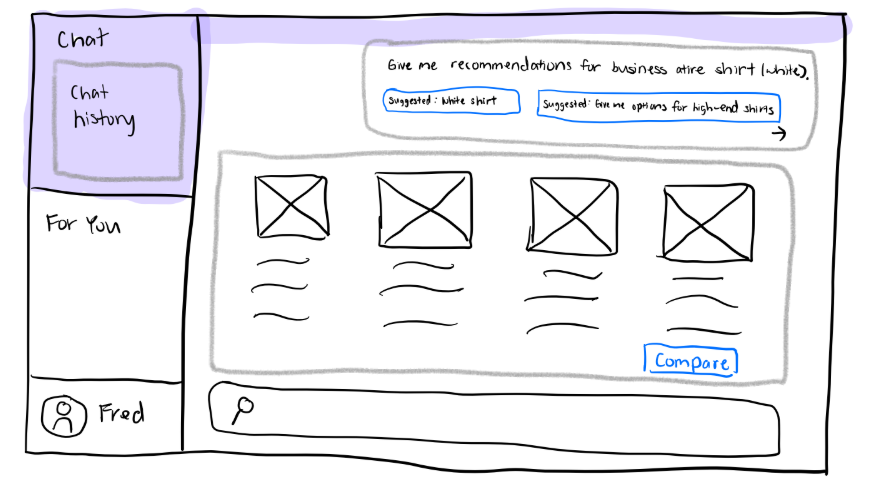
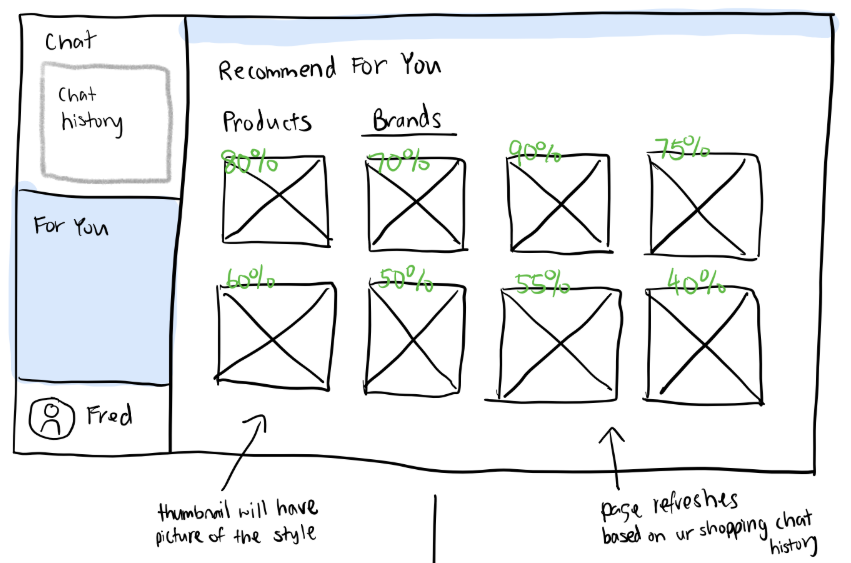
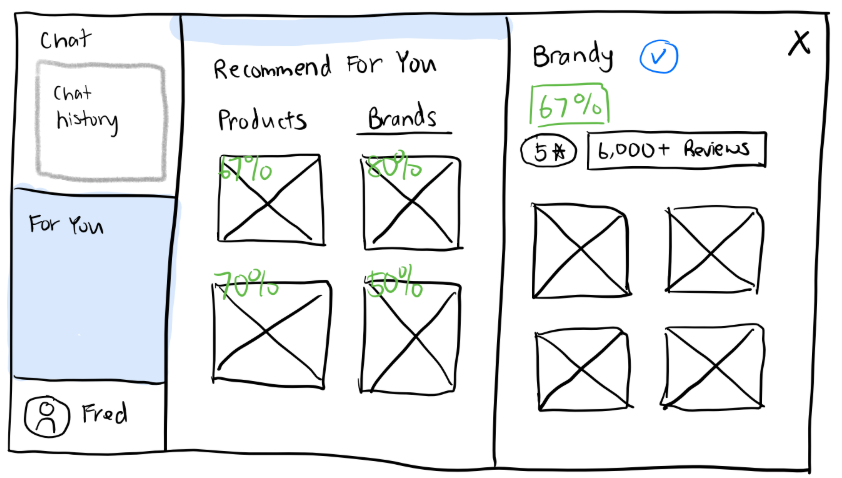
I came up with an AI-powered, fashion shopping platform on desktop, where users could discover a variety of brands and products tailored to their needs and preferences.

One of my team members sketched it up, as seen below.
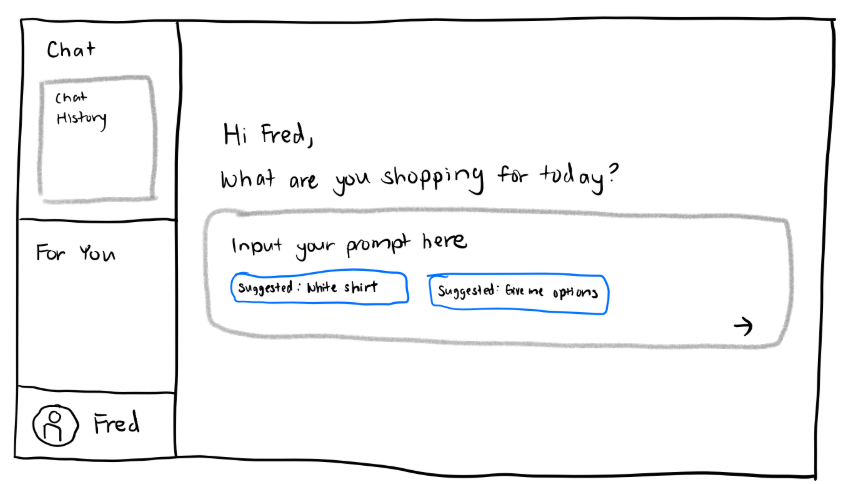
Birdie Sketch: Landing Page Birdie Sketch: Product Search
Birdie Sketch: For You Birdie Sketch: For You Brand Display

Across all user tests on different sketches of our ideas, this one was consistently most liked.

Users liked how it was like a one-stop-shop for clothing shopping. They could do everything, from searching for items to researching certain products or brands.

Design: Prototyping

From there, we upped the fidelity with some Figma wireframes. This got us to think more about turning feedback from users into a strong information architecture, containing easy-to-use features for all necessary user flows.

More Coming Soon...

But feel free to check out the Figma file here!